

Penaudio Cenya
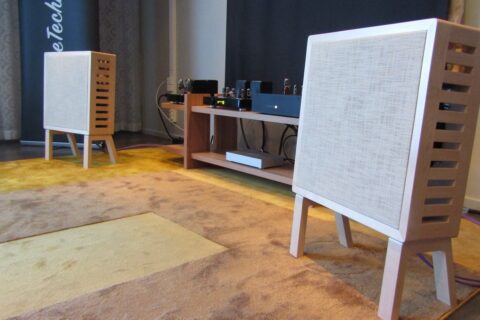
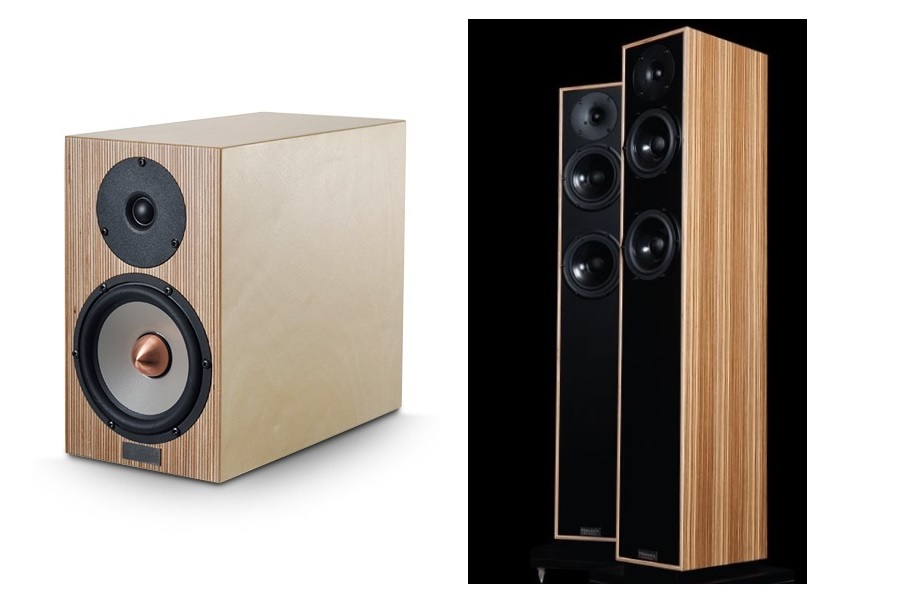
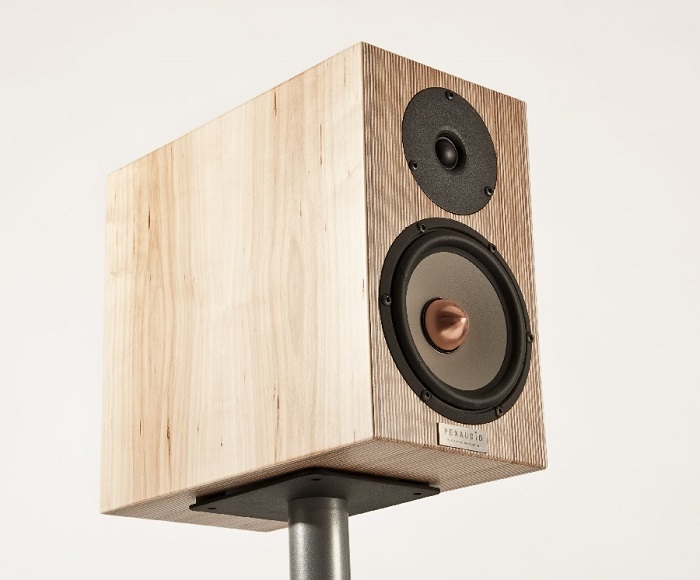
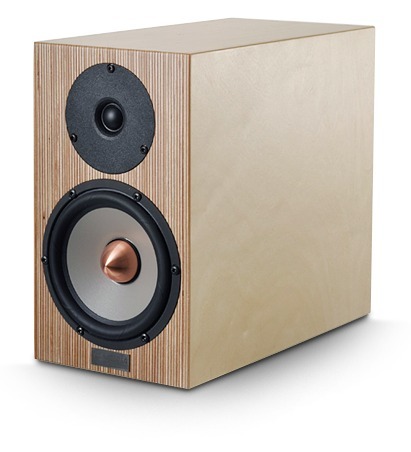
Design-wise, simply measuring it by eye, the new Penaudio Cenya must be one of the most successfully shaped standmount loudspeaker on the market. It is not quite as cool and sexy looking as the slimmer Charisma; what makes it look a bit more common is the 6 inch mid/woofer that makes the front panel wider. But it is nicely proportionated thanks to its depth (31cm) that exceeds the height (28cm) by a few cm’s. The form endows the speaker authority and weight that many other similar monitors lack. In fact, Cenya makes standard monitors with the height twice the depth look inferior, fool even.
The review individual was finished (the top, sides and the bottom) with an oak ply matching splendidly with the stripes of the 1,5mm Penaudio Birch Plywood veneer (front and rear). The cabinet itself is made of 19mm Finnish MDF. Penaudio’s loudspeakers – all of them – have a rare property that they let the wood come forward in the raw and shine in the most natural way without artificial glimmmery. The new Cenya is no exception. It is not overdone, swanky. Just a piece of honest wood work. Italian designers certainly have other ideas, but this design deviates also from the Danish ones with which Penaudio otherwise bears kinship.
The form of the cabinet is appealing but how about stands? Stands didn’t come along but the design of the Cenya certainly poses the question of an aesthetically suitable stand. For reasons explained later, Cenya has to be placed on a stand, and not be hidden in a bookshelf, nor kept near the neigboring walls. I’ve seen pictures of Cenya standing on top of a round pipe. Not good, not good at all. The speaker looks like an orphan. It cannot be that difficult to design a stand that would compliment the design of the Cenya. But is there such a stand available on the market?
The new Cenya is a 2-way 4-ohm monitor. In addition to the 145mm Seas Excel magnesium coned mid/woofer (with heavy copper rings above and below the pole piece, and radial reinforced surround) the speaker features a 20mm ferrofluid cooled textile dome, it too coming from the Seas selection, and crossed at 4000 cycles. The announced frequency (anechoic) response +-3dB is 45-28000Hz, and in room 40-25000Hz. Other features include: WBT binding posts, Jorma Design internal wiring.
According to Penaudio’s own estimate, the Cenya (163x280x315mm) extends the dynamic range of Charisma while retaining the purity and liquidity of Rebel 3. Cenya borrows from the new speaker design concept first presented in the 2.5-way Sara. Cenya is a 2-way, 4-ohm reflex-loaded monitor with Finnish heritage and characteristics of craftsmanship, elegance and simplicity. The cabinet is 19mm Finnish MDF, both sides veneered with 1,5mm Penaudio Birch Plywood veneer.
Pricewise the new Cenya, 2995 euro, sits above the least expensive model Rebel3 (cost now only 995 euro per pair) and the 2495 euro Charisma, and below the 3995 euro Sara floorstander, and the flagship Serenade of 7995 euro.
Sonics in the first round
The official premiere of the Cenya took place at CES in January 2011, but I had a chance to audition the speaker briefly in a dealer’s shop, who had chosen to run them with Ayre electronics. The top octaves sounded elegant and pleasant, not too different from what I’ve accustomed to hear from Penaudio loudspeakers. The transition from the midrange to treble was aurally almost invisible, while the bass/lower midrange smoothness suffered from the long distance between the speaker and the wall behind it, and from the odd way the room behaves acoustically over the midbass range. Yet, Cenya’s bass was better – more legible – in that room than the bass of two much bigger and more expensive loudspeakers that happened to be present, pointing to the fact that small stand mount quality monitors are often more suitable for avoiding problems in the bass region and lower midrange.
All in all this first round auditioning gave an impression of a speaker with very likable and musical sound, being a living proof of the fact that good sound does not always presuppose mechanically manipulated directivity measures.
Second round chez moi
Next time I brought the Cenyas to my own listening room, where I’d have a chance to listen to them for a longer period of time. When I review a loudspeaker in my listening space, I don’t so much care about a speaker being good or bad, better or worse. My aim is just to understand and describe how (in which particular ways) the speaker sounds, and only that. To understand and describe a sound is fundamentally not a matter of hearing (perceiving) something but being able to conceptualize what one has heard. In this respect, hearing is essentially a cognitive and linguistic skill.
To start with, listening to Penadio Cenya was – again – a very pleasant experience. Not just in some vague general sense, but in a typical-to-Penaudio way. It would be unfair to Cenya to listen to music by studiously thinking what goes in the music. Cenya is not a speaker for musical dissection and analysis. Listening to music just like that, will reward the listener with a flutter of good will and spirit, like a soft summer wind. This is Penaudio as I’ve learned to know it.
Thanks to the sympathetic tonal character that dominates the sound, combined with certain calmness of the overall performance, Cenya can appropriate different kinds of music styles and genres without contradiction or aggression. Audiophile Test-CDs with diverse music samples cause no headache to Cenya. Being an omnivore does not preclude the loudspeaker having its own favorites: the Cenya kind of gently persuades the listener to develop listening habits toward soft and not too complex vocal music. Also, instruments such as an acoustic guitar, sound particularly resonant with Cenya.
Cenya sounds clean and open without appearing especially revelatory. Once again Penaudio shows how to balance between analycity and warmth. In a tradoff-situation, the speaker prefers the latter. But even when the sound feels sweet, mellow and fairly full-bodied, it does not become straighforwardly dull. It sounds pleasurable but in a quick-minded way. This I regard as an achievement.
There are two quite obvious reasons why the Cenya is unlikely to irritate any normal music listener sauf audiophile purists, perhaps. One is its bass and the other is its treble. In this respect too Cenya reminded me of other Penaudio speakers, the Sinfonia most lately.
Cenya has enormous reserves of bass energy for its size. If I’m asked it can fill in even a larger room with a luscious bass. My listening room is not a big one but it opens up from both sides to another room so that speakers have volume to breath and spread out their bass reservoirs. I’ve got several loudspeakers in my room, some ten times bigger than the Cenya, and not one has managed to boost the bass frequencies and wake up room resonances in an unacceptable manner. Nor did Cenya (80cm from the wall behind) but it also made it quite clear that it should not be given a chance to do so either.
Thanks to its bass potential, the Cenya can make an electric bass sound strong and cool; it can make a piano sound surprisingly believable and full-bodied; etc. But at the same time it’s also clear that it’s the bass that is behind the Cenya’s enchantingly generous and pleasant overall sound. There is a risk of danger too. In order to prevent the bass from dominating, the speaker must not allowed to emphasize its bass reserves eg. by keeping it too close to the walls. The risk is not just a colored bass, but also inappropriately forgiving sounding music. Some people might like it but I’m sure majority would be in favor of a more realistic performance.
Let me make my point clear. I once heard a speaker with a vintage 8″ widebandwidth driver. It wasn’t a remarkable speaker. The sound was dry and rather bassless. Yet only very rarely have I heard a sound that would more favourably support eg. Bach’s violin/piano sonatas. The reason why it worked so greatly was that the midrange was void of any backing by the low frequency reproduction, say, below 400Hz! It wasn’t the most pleasant sound but damn beautiful it was.
The Cenya sounds pure and clean and distortionless, but is not meant to sound like a naked mid-range specialist. To make Cenya sound even partly as the mentioned vintage speaker, no extra help from the room is to be accepted. For most of us a little help from the room is not a problem, but purists need to work out a position for Cenya where it would deliver as much as possible the direct sound, and as little as possible the reflected sound.
And then the treble. The new Seas tweeter is capable of producing very sophisticated, fine-grained high frequency contents. Even the highest harmonic overtones remain atypically informative. This property gives a certain silky character to Cenya’s HF performance, and adds to the overall amenity of the sound. But how distinctive is the treble? I got the feeling that the treble was somewhat incongruent. This can best be heard as a certain “thinness”, not as such, but in relation to the midrange (ie. below 4000Hz).
Imagine that a violinist plays three octaves starting from the open D string. As she gets higher, the notes gets naturally and gradually more pointed and restricted. What Cenya appears to do is that somewhere in the middle, from a certain note upwards, it makes the notes sound as if they were from an octave higher than they actually are. Here a tad more presence, width and energy (cymbals and saxphones would also have benefitted) would have been preferable.
I’m quite sure that the bass that gets easily exited, and the silky but somewhat small-sounding treble, are not random qualities of the Cenya but something that people at Penaudio are fully aware of. These qualities as well as the harmonious and positive midrange are part of how Penaudio loudspeakers are designed to sound. They are active ingredients of the “auditive well-being” that Penaudio famously speaks for in its design philosophy.
Two final points. Any soundstage? Yes, but I don’t think the soundstage is the number one variable for the Cenya (nor to me). The center image is not noticeably strong: even mono recordings hover around the centre point rather than be steadfastly fixed to it (at least in my room). The music spreads evenly between the speakers and the depth of the sound is not pronounced. The sound is not forced to escape onto the back stage, which is why the Cenya does not sound distant or distracted, and which is good too.
Second. Most of the time I drove the Cenya – against Penaudio’s recommendations – with a 10-15W PP tube amp from its 4 ohm taps. I had no problem with the volume of the sound from the distance of roughly 3 metres, nor did I notice errors related to compressed dynamics, increased distorion etc. A standard transistor amp did not change the situation much in my case but should the controllability of the bass become a problem, high-power transistor amp is probably the truest amplifier for Cenya. However, care should be taken that Cenya’s qualitites in the midrange are not annuled in the process, which was why I ended up in using the tube amp.
Specifications
Type: 2-way, stand mounted, reflex loaded; Drive units: ¾”(20mm) ferrofluid cooled textile dome tweeter (Seas), 6”(145mm)magnesium coned midrange/bass (Seas Excel) with heavy copper rings above and below pole piece, radial reinforced surround; Cross-over: 4000Hz; Frequency range: anechoic response +-3dB 45-28000Hz, in room response 40-25000Hz; Sensitivity: 86dB/1m/2.83V; Nominal impedance: 4ohms; Recommended amplifier: 50+W; Dimensions (WxHxD): (163x280x315)mm; Weight: 8kg. Specialities: Jorma Design wiring, Seas custom / excel drivers, WBT 0730.12 (Signature platinum) pole screws, SCR polypropylene capacitors, Graditech air-core inductors, aluminium reflex pipe, custom made finnish birch plywood veneer 22mm/16mm solid plywood cabinet.
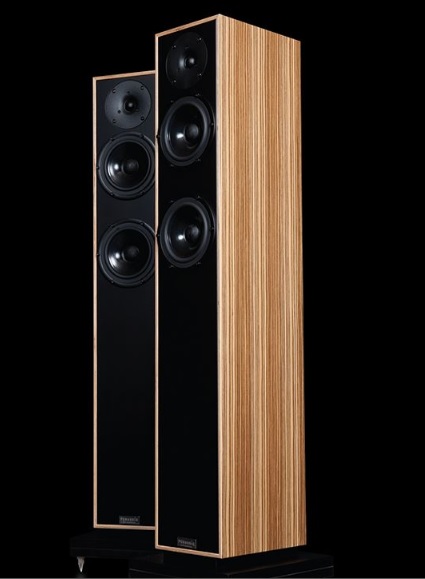
Penaudio Rebel Three
Penaudio used to be a one man’s dream. With his loudspeakers Sami Penttilä wanted to express, convey and share similar feelings of living well that he personally retrieved, say, from Italian dishes or from a handful of sportcars in the front yard. He pursued his goal by being careful about what goes in his loudspeakers – drivers especially – but also by inventing a stylistic use of plywood that soon became the trademark for Penaudio.
Today Penaudio has joined forces with a Latvian company Worldaudiodistribution. The purpose of the move was to make better loudspeakers available for a larger audience. The division of labour is such that the WAD takes care of the assembly line and administrative business, Penttilä still functioning as the head designer, and the cabinets being manufactured by the same Finnish company as before.
“I still design and tune the new speaker models, which are then listened hundreds of hours with variety of music, including some self-recorded. Nowadays when we choose components we pay closer attention to their impedance behaviour in order to make our speakers more electronics friendly and more suitable for different musical preferences”, Sami Penttilä reports.
Under the new arrangement Penaudio sports five speaker lines. On top there’s the Sinfonia-line with Sinfonietta ja the flagship Sinfonia. Next below is Penttilä’s own Signature-line with Cenya Signature ja Sara S Signature, slightly bigger speakers than their non-signature siblings, the former featuring fancier connectors, the Seas Crescendo tweeter and expensive curly birch and rosewood finishing.
Apart from the fact that from here on all Penaudio speakers come with a magnetic grill, and are available in a wider selection of finishes, both the Signature and Sinfonia serieses have undergone no changes. The other two lines, Rebel and Charisma, are however more or less new creations.
The Charisma-line equals to Charisma, Cenya and Sara S (incl. Charisma C and Cenya C). They sport Seas magnesiumin mid/woofers and the good old Penaudio veneer look. The entry-level Rebel-line ranges from Rebel Two to Rebel Four (plus Rebel S and Rebel C). Common to all the Rebels is the paper cone Seas mid/woofer and a new Wavecor 22mm tweeter. Although Rebels do not come with the traditional Penaudio look, their overall appearance is unmistakably genuine Penaudio.
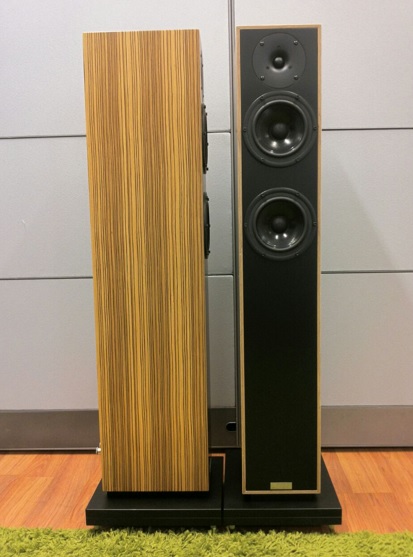
The mid-class rebel
The topic of today, the 2,5-way Rebel Three, could be easily be mistaken for an upgraded Sara in that the internal volume, the 15cm Seas mid/woofer, and WBT terminals haven’t changed, but everything else has: the Wavecor tweeter, the crossover, Jantzen Audio coils, tailor-made Supra internal cabling etc.
The new Wavecor tweeter is a 22mm low resonance 4 ohm soft dome model with a 22 mm voice coil and wide surround caters. The unit comes with the EVA gasket.
Hard to tell which is more important to the new design sound-wise: sticking to the proven paper coned mid/woofer or having a new textile tweeter with all the resulting consequencies to the design. The fact is, however, that the new tweeter has made it possible for Penaudio to lower the crossover point by 500Hz making the life of the mid-woofer easier by narrowing its operating range.
At 4400Hz the X-over point still is an octave higher than on average to accommodate Penaudio’s design philosophy according to which, fundaments of all instruments, and a major part of their timbre, must be reproduced with one single element, in this case the Seas mid-woofer. With the new design Penttilä also believes to have achieved a “natural” directivity in contrast to speakers in which directivity is controlled with a shallow horn.
The duty for reproducing the bass/lower midrange is split between the two mid/woofers so that from 300Hz up only one of them is in operation. Hence, the 2.5 way.
The cabinet (top, bottom and side panels) is made of ply while the front and rear panels are MDF. The use of two different materials not only helps to add interesting contrast to the outlook but also, according to the manufacturer, contributes to the reduction of cabinet resonances. The cabinet is damped with foam and sythetic cotton. Internal cables too are damped and fastened to the cabinet with foam rings.
Like all Penaudio speakers the Rebel Three looks elegant in an honest, natural way. Just watch it for a bit longer period of time, and you’ll see that its commonness is deceptive. Rebel Three is available in (front and rear black) birch, oak, teak, black ash, matt white and matt black, plus for extra money, piano black and piano white.
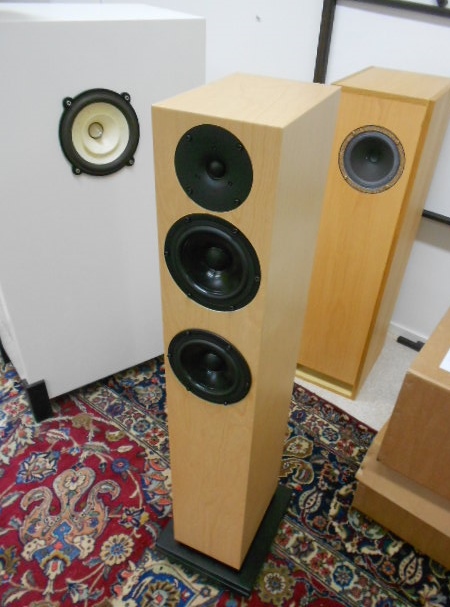
Preparing for listening
Before listening experiments the two-layer bottom plate was lifted on four fair-sized spikes, and between spikes and the floor came Cold Ray Spike Pads (Cold Ray is better known for its vibration & resonance cones and diffusers). The speakers were then placed not too far (2,5m) from the listening seat, well over one meter from the wall behind, slightly turned toward the hot spot, and the seat a half meter outside the 60 degree stereo triangle.
The source was a modified Sony professional CD-player connected via an active (tubed) and passive preamp to Burson Audio’s 230W Timekeeper mono blocks (two stereo amps bridged). The Three’s (the crossover) is designed to be fairly amplification friendly, and there was no doubt that the Timekeepers (Corfac & Gregitech speaker cables) offered the Threes (87dB sensitivity, 4ohm load) a very good match both technically and sonically (as did a Naim integrated by the way). Still I’d not exclude a quality 30-50W tube amp from the pool of possible amps for the Threes; my 20W PP tube power amp, apart from a slight lack of energy, did fine job with the speaker.
Listening
Prior anything else I was keen on finding out whether the “new” Penaudio Rebel would still sound “pleasant” in that peculiar-to-Penaudio way that I remember from the past, and that characterized more or less all Penaudio speakers models independently of the Series. After having auditioned the Threes for weeks, I could assure you – and me – that the special quality is still there although somewhat differently served.
There’s something “sweet” about how the Three sounds, and I’d not relate this quality to some properties of its frequency response. The question is about the overall impression. Sweet as a puppy, sweet as a person, who is especially kind to us, is sweet. On the other hand, I also sensed that the sound has gained consistency and systemacy that makes the pleasure component come to the fore in a more polite and undemonstrative manner. Music now flows more securely, more focusedly and more intensely. The pleasure is not as first-hand.
I (my brains) interpreted the “new” treble as being quite “going with the nature”, neither sparkling, nor matt. The HF content of the music was introduced largely “invisibly” to the ear, which to me always stands as a sign of a success.
Although the treble performance of the Three showed adequacy, both quantitatively and qualitatively, it could’ve been a degree more refined. By this I mean that while not making the violins of a string quartet (a sample recording) sound unnecessarily soft, nor shouting out the high-pitched character of string instruments, the Three voluntarily let the midrange be the king of the hill.
The open and luminous midrange turned out to be positively tolerant toward many sorts of music from solo cello pieces to various vocal presentations, classical or pop. What makes the midrange of the Three appealing is its optimism rather than extreme accuracy. Thanks to this quality the Three is responsive to so called compilation CD’s with classic, pop and jazz. However, and as in the past, the Three is a true Penaudio speaker in that it knows how to communicate vocal music.
The Three would not be part of the Penaudio gang if the mid-bass/upper-bass/lower midrange would sound skinny and famished. It seems to me that it’s part of the Penaudio concept that speakers ought not give up this “warmth region” even at the risk of occasionally delivering a bit too much of it (it’s called “bass presence” in the Penaudio literature).
As a result, there were moments when I got too much of bass/lower mids, and sometimes when the bass wasn’t present, which I interpreted so that the speaker tried hard to keep the boom inside the cabinet. But that was in my room. Maybe the room was too small, as Penaudio stresses: the size of the room matters.
Interestingly, I heard the Three in another surrounding, a slightly more volumenous room, and there the bass performance was semi-perfect, nicely supporting the programme material. This shows how unrewarding, if not impossible, it is to objectively evaluate the bass of a speaker, of any sort. On the other hand, I think the Three is one of the speakers for which the best position must be searched for with patience.
Conclusion
All in all, the latest Rebel of Penaudio, the Rebel Three, proved not to deviate from the Penaudio’s common path, neither visually nor sonically, in a way that would expel loyal Penaudio fans. Who knows, a step or two more systematic sound world of this design may invite new music listeners to become Penaudio’s friend, particularly now when economies of scale, better logistics etc. has helped Penaudio to substantially lower the price of its speakers.
Penaudio Three cost 2395 euro for a pair. What one gets for the money is a hifi-loudspeaker in the best sense of the word, ie. a more civilized sound reproducer than a large spectrum of wannabe hi-fi speakers, yet not quite as literate and educated as top highend-speakers. In a word, the Rebel Three a competent premium-level all-arounder with a good value for the money.